Posts

Showing posts with the label Indian archaeology

Guest Article - Indian Mythology Series: Revanta
Image
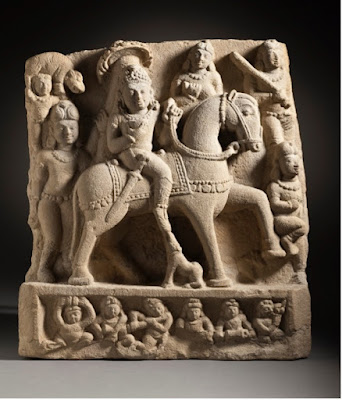
Sun, one of the primordial elements of Nature, is present as a revered deity in so many cultures. He is considered a life-giver and as many of us know and understand today is also known to cause heat waves. His role in Indian mythology is rather important and has a well-established cult in the country. We have very beautiful and elaborately planned temples dedicated to Surya. There’s more to Surya than just a life source and heat waves. Surya, according to Vishnu, Matsya, Kurma, Markandeya and Devi Bhagavata Puranas has an entire family tree, with wives and children. The solar deity is the father to many of minor deities like Manu, Yama, Yami, Shani, etc. The youngest of his children is Revanta or Raivata.    Mythology It is common to note that Indian deities are known to shape-shift and Surya is no exception. According to the story, his wife Saranya or Sanjna is said to have been unable to bear the heat of Surya (just like the summer months of today) and took the form of a ma...

The Story of Odisha’s Maritime Trade

Image
When one thinks about the maritime trade of ancient India, the first ports that come to mind are usually Lothal, Bharuch, Bassein, Muziris, Pattanam, etc. Today let’s explore the lesser-known tales of the ports of Odisha from the eastern coastline, and their role in shaping India’s maritime past. Due to poor preservation conditions, the earliest reported shipwrecks from the Indian coastline all date post 16 th century CE (Common Era). In the absence of direct evidence, indirect sources inform us about Odisha’s contacts with the Southeast Asian and Roman regions. These sources are often in the form of literary texts, inscriptions, coins, pottery and iconographic evidence. In the historical sources, Odisha has been referred to by various names as Udra Desa, Kalinga, Utkal and Orissa. The significance of Odisha in the maritime trade is observed in the popular literary works such as Raghuvamsa (an epic poem written in 19 cantos), in which Kalidasa refers to the king of Kalinga as ‘ Mahoda...

Mirror, mirror, on the wall!

Image
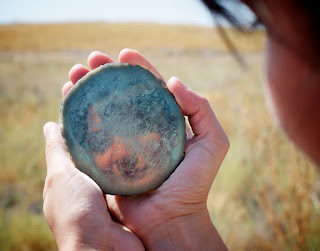
Once upon a time there was a man named Narcissus, a hunter in the Greek mythology, apparently renowned for his beauty. Narcissus was the son of the river god Cephissus and the lymph Liorope. One fine day while Narcissus was on a hunt, he came across a nymph, Echo. She saw his beauty and immediately fell for him. Echo tried to pursue him but Narcissus wouldn’t have any of it. He pushed her away and asked her not to trouble him thereafter. Echo was thus disheartened for life. When Nemesis, the goddess of revenge, came to know of the incident, she decided to teach Narcissus a lesson. She led him to a pool of water, wherein he saw his own reflection and thought it to be of someone else’s and fell in love with it. It was only later that he realised what he saw was his own reflection. He fell in despair because his love could not be reciprocated and he subsequently burnt in passion, turning into a golden and yellow coloured flower. From this story is derived our present usage of the term ‘na...

Pursuing a doctoral in Archaeology in the midst of a pandemic: a state of incertitude and quandary

In September 2021, it will be three years since I enrolled for my PhD program. Normally, I'd be expected to be somewhere in the middle of completing my research or nearing towards the end of it. When I joined the course, I was determined to submit my thesis in three and a half years maximum. Now before I write anything else, let me first tell you about my topic of research. The subject that I have chosen to work on is not employed in mainstream archaeological application in India. At the time of applying I was very well aware of this fact and looked at it as a challenge that I thought I could take on (I still think I can). So you see, the research subject already had its limitations when I enrolled. It took me a good one and a half year to find a collaboration to get my samples processed into data that I could analyse. This collaboration I found at a department in Delhi University. I travelled there with the soil samples in February 2020 and prepared them for the initial stage. Due...

Combs in Archaeology

Image
You’re probably wondering why on earth did I choose to write about combs?!!! Well, a few weeks ago, I noticed a very unusual long wooden comb in my house that had tines on both ends. I asked my mother why does it look different and I was told it is a louse comb. It suddenly occurred to me that a little thing such as comb is a part of the basic grooming kit and would have been as important to the olden people as it is to us Rapunzels with long hair! (in no way implying that people with short hair don’t use combs). So anyway, it followed that I looked up combs in the archaeological record and to my surprise, I came across various articles from all around the world. I never thought that an object like comb could be a subject to such intricate carvings and motifs as I shall discuss about shortly. It seemed like the perfect first daily archaeological object to be blogged about. The exact kind of comb I was intrigued by! In my mother tongue i.e. Gujarati, a daily use comb is referred to as a...