Posts

Showing posts with the label culture

Guest Article - Indian Mythology Series: Revanta
Image
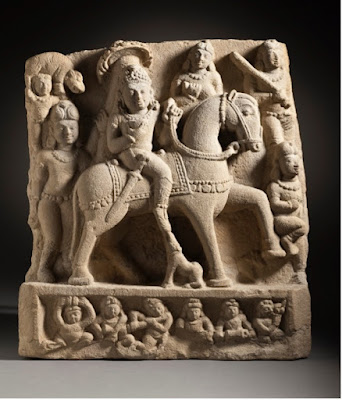
Sun, one of the primordial elements of Nature, is present as a revered deity in so many cultures. He is considered a life-giver and as many of us know and understand today is also known to cause heat waves. His role in Indian mythology is rather important and has a well-established cult in the country. We have very beautiful and elaborately planned temples dedicated to Surya. There’s more to Surya than just a life source and heat waves. Surya, according to Vishnu, Matsya, Kurma, Markandeya and Devi Bhagavata Puranas has an entire family tree, with wives and children. The solar deity is the father to many of minor deities like Manu, Yama, Yami, Shani, etc. The youngest of his children is Revanta or Raivata.    Mythology It is common to note that Indian deities are known to shape-shift and Surya is no exception. According to the story, his wife Saranya or Sanjna is said to have been unable to bear the heat of Surya (just like the summer months of today) and took the form of a ma...

Guest Article - Indian Mythology Series: Mohini Avatar of Lord Vishnu

Image
Indian mythology is filled with complex characters who are set in designated patterns and narratives. They are all assigned spaces and purposes – to impart a lesson. It is shed either in a positive or negative light. In the Hindu pantheon, it is a common feature for any deity/ divine being to have the ability to shape-shift. Changing forms or avatāras give rise to other beings which are present for a different purpose. This gives rise to more stories and they end up being cultic figures on their own or enhancing the cult of their primary form. One such deity is Vishnu who, apart from being a part of the Trinity is known to have many forms. One of them is a beautiful woman called Mohini. She has been mentioned in a few Puranas like Vishnu Purana, Kūrma Purana, Agni Purana, the Ramayana, and the Mahabharata. Albeit small, she finds a rather important place in Hindu mythos.  Legends and stories Mohini is first introduced in the story of the churning of the ocean. The devas and the asu...

Bead ornaments in the archaeological record

Image
They say “A Diamond is Forever''. But is it really the case? Well, diamonds have not exactly been around ‘forever’ in the jewellery market, until De Beers Consolidated Mines, Ltd. used the slogan to channel the consumer demands by marketing diamonds as being the symbol of eternal love. So then what exactly was the ornament type preferred by our good ol’ prehistoric folks? Before metal was discovered, the prehistoric humans used to fashion necklaces, earrings and other ornaments out of raw materials such as semi-precious stones, mollusc shells, animal teeth, eggshells, presumably flowers and bird feathers as well. Few or most of these materials were usually available in their vicinity. If you have read the earlier article I wrote about shells , then you probably know that they were frequently used to craft ornaments. But what I found surprising while researching for this article is that shell beads might have links with development of language in humans! Mind boggling right? Mar...

The Story of Odisha’s Maritime Trade

Image
When one thinks about the maritime trade of ancient India, the first ports that come to mind are usually Lothal, Bharuch, Bassein, Muziris, Pattanam, etc. Today let’s explore the lesser-known tales of the ports of Odisha from the eastern coastline, and their role in shaping India’s maritime past. Due to poor preservation conditions, the earliest reported shipwrecks from the Indian coastline all date post 16 th century CE (Common Era). In the absence of direct evidence, indirect sources inform us about Odisha’s contacts with the Southeast Asian and Roman regions. These sources are often in the form of literary texts, inscriptions, coins, pottery and iconographic evidence. In the historical sources, Odisha has been referred to by various names as Udra Desa, Kalinga, Utkal and Orissa. The significance of Odisha in the maritime trade is observed in the popular literary works such as Raghuvamsa (an epic poem written in 19 cantos), in which Kalidasa refers to the king of Kalinga as ‘ Mahoda...

She sells sea shells on the sea shore… !

Image
Do you ever go to the beach and are really fascinated by all the different types of shells? Even before I pursued archaeology, I was (am) the girl who loved collecting shells from beaches she visited. I even wore earrings and necklaces made of shells (I still do, sometimes). I did not understand their morphology (form) as I do now but just the fact that they come in such different shapes, sizes, colours and patterns got me hooked. As it happens, I am not the first person to be so fascinated by shells. From thousands of years ago, the prehistoric people loved collecting and adorning themselves with shells too. The oldest example of shells used as jewellery comes from the prehistoric site of Skhul in Israel. Shells of a certain species (gastropod - Nassarius gibbosulus ) were found with perforations from the same layer as 10 human fossils. Archaeologists believe these were used as beads for ornamentation by early humans. The layer from which shells were found is dated to 100,000 - 135,00...

Mirror, mirror, on the wall!

Image
Once upon a time there was a man named Narcissus, a hunter in the Greek mythology, apparently renowned for his beauty. Narcissus was the son of the river god Cephissus and the lymph Liorope. One fine day while Narcissus was on a hunt, he came across a nymph, Echo. She saw his beauty and immediately fell for him. Echo tried to pursue him but Narcissus wouldn’t have any of it. He pushed her away and asked her not to trouble him thereafter. Echo was thus disheartened for life. When Nemesis, the goddess of revenge, came to know of the incident, she decided to teach Narcissus a lesson. She led him to a pool of water, wherein he saw his own reflection and thought it to be of someone else’s and fell in love with it. It was only later that he realised what he saw was his own reflection. He fell in despair because his love could not be reciprocated and he subsequently burnt in passion, turning into a golden and yellow coloured flower. From this story is derived our present usage of the term ‘na...