Posts

Showing posts with the label environmental archaeology

Lessons from Lost Habitats - A Basic Understanding of Environmental Archaeology

Image
Having spent almost a decade studying this specific sub-discipline, I think it is time to try and write a non-boring piece on the topic. I use the term ‘non-boring’ here because to most people archaeology is interesting when it involves huge monuments, conspiracy theories including aliens, or has to do with investigating the mythological/ religious scriptures! Even within the archaeological community, environmental archaeology is perceived as a ‘very-science-y’ niche and not many choose to study it. But what exactly does the term mean? How does it help archaeologists reconstruct the past? And just how science-y is it? I will try my best to simplify it. Let’s dive into it!  Imagine yourself as a Neolithic human. Let’s suppose that you are looking for a place to settle down with your community - you’ve decided that you don’t want to be a hunter-gatherer anymore! You want to farm and cultivate your own food. What resources would you require in order to shift to a sedentary lifestyle? ...
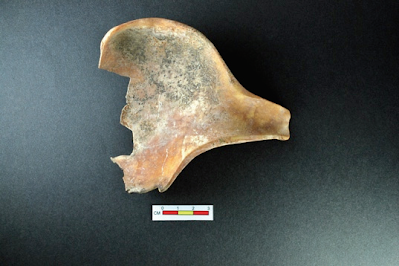
She sells sea shells on the sea shore… !

Image
Do you ever go to the beach and are really fascinated by all the different types of shells? Even before I pursued archaeology, I was (am) the girl who loved collecting shells from beaches she visited. I even wore earrings and necklaces made of shells (I still do, sometimes). I did not understand their morphology (form) as I do now but just the fact that they come in such different shapes, sizes, colours and patterns got me hooked. As it happens, I am not the first person to be so fascinated by shells. From thousands of years ago, the prehistoric people loved collecting and adorning themselves with shells too. The oldest example of shells used as jewellery comes from the prehistoric site of Skhul in Israel. Shells of a certain species (gastropod - Nassarius gibbosulus ) were found with perforations from the same layer as 10 human fossils. Archaeologists believe these were used as beads for ornamentation by early humans. The layer from which shells were found is dated to 100,000 - 135,00...

Master’s in Archaeology from England

I am quickly going to do a small piece on what the master’s degree in archaeology would look like in England. This is for the aspirants who are looking to do their post-graduation from the UK and want an idea of what to look forward to. The postgraduate taught master’s degrees in England are usually one to two year long in duration when pursued full-time. Part time masters can be anywhere between two to four years long. There are also two types of master’s degrees in England - taught and research based. The research based one is more close to what we call MPhil in India and the taught degree is like the regular master’s where the course is taught by lecturers.   The structure of the course depends on the subject of the master’s. For instance, I studied MSc Environmental Archaeology, so as the title suggests all the course modules were related to/ centered around that particular topic. There are a vast range of options to choose from for all the semesters except a few compulsory/ co...

Ancient Humans and their Cats

While I was pondering upon the topic of my next article, I thought of writing about the evidence of dogs and their role in the lives of ancient humans. While recalling zooarchaeology classes from my masters days, it occurred to me that we were never taught about cat domestication. So I started exploring how and when did cats get introduced into the domestic households and consequently decided to write about it. Dogs have been domesticated as pets in every sense, however, cats are really only tamed. Dog remains have been reported in plenty from the archaeological record in contrast to the limited cat remains. Dogs had a purpose for being domesticated i.e. providing security in return for consistent food supply and shelter but I wonder what such purpose did cats serve when they first began living amidst human settlements? The relationship between cats and humans is believed to have started through commensalism. The term commensal simply means ‘eating at the same table’ or in this particu...

Studying Archaeology Abroad: Insights

I have been approached by my juniors and aspiring archaeologists many a times for guidance in applying for studying archaeology outside of India. I finally decided to blog about it so now I can direct people to this link and let them read in detail about the various possibilities. If you are reading this now, hi! I will try to make this article as insightful as I can. At the end of this article, I have listed a few universities, both in India and abroad to get you started.  If any doubts persist after you have read this, feel free to reach out to me. There are two ways to go about this: 1. You are looking to study abroad and want to settle outside India in the future. 2. You are looking forward to training abroad and coming back to India and plan to pursue your career in the country For all the people whose preference is the first option, you all have plenty of options to choose from. If you do not plan on pursuing higher studies, I would recommend you complete your Bachelors in Ar...