Posts

Showing posts with the label All Things Archaeology

Lessons from Lost Habitats - A Basic Understanding of Environmental Archaeology

Image
Having spent almost a decade studying this specific sub-discipline, I think it is time to try and write a non-boring piece on the topic. I use the term ‘non-boring’ here because to most people archaeology is interesting when it involves huge monuments, conspiracy theories including aliens, or has to do with investigating the mythological/ religious scriptures! Even within the archaeological community, environmental archaeology is perceived as a ‘very-science-y’ niche and not many choose to study it. But what exactly does the term mean? How does it help archaeologists reconstruct the past? And just how science-y is it? I will try my best to simplify it. Let’s dive into it!  Imagine yourself as a Neolithic human. Let’s suppose that you are looking for a place to settle down with your community - you’ve decided that you don’t want to be a hunter-gatherer anymore! You want to farm and cultivate your own food. What resources would you require in order to shift to a sedentary lifestyle? ...

Elephanta Caves: The Rock-cut Temple dedicated to Shiva

Image
I have been meaning to write about this since it was requested sometime during the last year (yes, that long!). My apologies for the delay - I was so excited about getting back to writing the blog, but probably from writing the thesis I ended up having what they call a writer’s block. A few days ago I was reading an article on another blog I follow, and suddenly I felt inspired to write again, so here we are!  The name Elephanta brings back a lot of memories from different years of life. I remember visiting it as a picnic spot with my family when I was a school kid some twenty odd years ago. The Island is located about 10 km off the coast of Mumbai and is accessible by ferries and launches during the day; these can be boarded from the Gateway of India. It roughly takes an hour-long boat ride to get there. After alighting on the pier, there is an option of boarding a toy train which drops the tourists upto the foothill from where the ascent to the island begins. Imagine my excitemen...

Guest Article - Indian Mythology Series: Revanta

Image
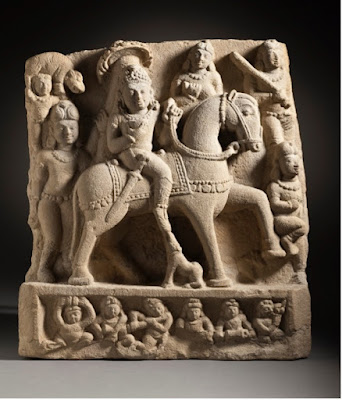
Sun, one of the primordial elements of Nature, is present as a revered deity in so many cultures. He is considered a life-giver and as many of us know and understand today is also known to cause heat waves. His role in Indian mythology is rather important and has a well-established cult in the country. We have very beautiful and elaborately planned temples dedicated to Surya. There’s more to Surya than just a life source and heat waves. Surya, according to Vishnu, Matsya, Kurma, Markandeya and Devi Bhagavata Puranas has an entire family tree, with wives and children. The solar deity is the father to many of minor deities like Manu, Yama, Yami, Shani, etc. The youngest of his children is Revanta or Raivata.    Mythology It is common to note that Indian deities are known to shape-shift and Surya is no exception. According to the story, his wife Saranya or Sanjna is said to have been unable to bear the heat of Surya (just like the summer months of today) and took the form of a ma...

The 2022-23 Hiatus!

  Hello dear readers! I have been MIA on the blog since the last year and a half, or more probably. Too many things were happening, but majorly I was focusing on completing my doctoral thesis. Now that most of the academic writing work is taken care of, I can get back to enjoying writing this blog! I am considering what new topics to write about. I have a few at hand which I am working on, at the moment. If anyone has any particular concept or topic they'd like to read about, do comment below and let me know. Also, in another news, I am moving out of the world of academia. Excited to find out what's in store for me next. Stay tuned for some amazing write-ups coming up on the page soon. Till then, take care. Cheers, B.

Bead ornaments in the archaeological record

Image
They say “A Diamond is Forever''. But is it really the case? Well, diamonds have not exactly been around ‘forever’ in the jewellery market, until De Beers Consolidated Mines, Ltd. used the slogan to channel the consumer demands by marketing diamonds as being the symbol of eternal love. So then what exactly was the ornament type preferred by our good ol’ prehistoric folks? Before metal was discovered, the prehistoric humans used to fashion necklaces, earrings and other ornaments out of raw materials such as semi-precious stones, mollusc shells, animal teeth, eggshells, presumably flowers and bird feathers as well. Few or most of these materials were usually available in their vicinity. If you have read the earlier article I wrote about shells , then you probably know that they were frequently used to craft ornaments. But what I found surprising while researching for this article is that shell beads might have links with development of language in humans! Mind boggling right? Mar...

The Story of Odisha’s Maritime Trade

Image
When one thinks about the maritime trade of ancient India, the first ports that come to mind are usually Lothal, Bharuch, Bassein, Muziris, Pattanam, etc. Today let’s explore the lesser-known tales of the ports of Odisha from the eastern coastline, and their role in shaping India’s maritime past. Due to poor preservation conditions, the earliest reported shipwrecks from the Indian coastline all date post 16 th century CE (Common Era). In the absence of direct evidence, indirect sources inform us about Odisha’s contacts with the Southeast Asian and Roman regions. These sources are often in the form of literary texts, inscriptions, coins, pottery and iconographic evidence. In the historical sources, Odisha has been referred to by various names as Udra Desa, Kalinga, Utkal and Orissa. The significance of Odisha in the maritime trade is observed in the popular literary works such as Raghuvamsa (an epic poem written in 19 cantos), in which Kalidasa refers to the king of Kalinga as ‘ Mahoda...